Issue 42
Chairman’s Report
I believe that our 2024 to 2025 season was a good year for the Ridware History Society. We had a great selection of speakers to inform and entertain us at our monthly meetings.
As an organisation, I think it is fair to say that the Ridware History Society is thriving. We only need to look at the membership list and the numbers attending the village hall for the monthly speakers’ meetings. However, I have to tell you that the same cannot be said for our organising committee. Most of your present committee has served for many years each, and have taken on various positions in order to keep the Society operating. It has now got to the stage where most of us would like to relinquish our place on the committee to pursue other interests. So, unless there is more interest shown soon in taking up the cudgels as it were, I’m afraid the Society will have to fold.
The existing committee will remain in post until the final meeting in March 2026. By then we will need a new committee in place, to take up the reins – planning the new programme for 2026/27 etc. (existing members will support the new committee through the transition up until the AGM of 2026.) We look forward to hearing your views at the October 6 2025 AGM. So, the future of the Ridware History Society, which has been in existence for well over 30 years now, is in your hands.
Finally, can I make a request for a volunteer who knows about desktop publishing (or knows someone who might like to help). And possibly, anyone who might know of a tame book publisher sympathetic to our requirements. We are exploring all avenues to keep our publications costs down to a reasonable level.
Chair: Roy Fallows
Talks Given by Speakers to RHS in the Winter Programme 2024 – 2025
4 October. Richard Totty – The Bawdy Courts of Lichfield
At our first meeting of the 2024/25 winter season, Richard Totty the chairman of the Friends of Staffordshire and Stoke on Trent Archives gave us a very interesting talk about church court case papers of the Consistory Court of the Diocese of Lichfield and Coventry held by Staffordshire Archives. He outlined the role of ecclesiastical courts in passing judgement on moral matters, including fornication, defamation and clergy discipline, leading to them gaining notoriety in the 17th century and the salacious nature of the cases and the statements of witnesses earned them the moniker ‘bawdy courts’.
The court records cover over 350 years of cases from the diocese with cause papers being a rich source of information, not only about the parties in the case but also the wider community. Although many of the cases naturally focused on Lichfield, Richard had examined a local issue which raised the question as to whether the area known as Rowley Park, in the manor of Agardsley, was actually in the parish of Yoxall as their churchwardens maintained or Hamstall Ridware. A dispute arose when in 1632 the bell frames in the parish church of Yoxall needed repair and, as was usual at that time, the churchwardens instigated a rate, or lewn, to be paid by all persons in the parish who were liable to pay church rates, that is everyone who had property. The owners of property at Rowley Park denied that it was in Yoxall and refused to pay the rate. Two of these were John Brickland, and Edward Hall, assessed jointly at 5 shillings; they said that Rowley Park was in the parish of Hamstall Ridware. Many very elderly inhabitants of both Yoxall and Hamstall Ridware were called to hopefully say that Rowley Park had always been part of Yoxall. These included a 99 year old widow, Margaret Gretton and Thomas Gretton who gave his age as 102. Typically, they described Rowley Park for ‘all the time of their remembrance’ which was 50 or 60 years ‘at the least’ and as it had been ‘for time beyond the memory of man’ in the parish of Hamstall Ridware. As the customs were often not written down, the collective memory of the older inhabitants was accepted as evidence. The court absolved the defendants and found against Yoxall which was a significant loss for the Yoxall churchwardens – not only did they lose the rates payable they would have had to pay the very considerable costs of the case.
For further interest, Richard suggested we look at the Lichfield Bawdy Courts Project Blog. Volunteer groups at the History Access Point at St Mary’s Church, Lichfield are currently transcribing papers from the court cases and producing blog posts about interesting stories that they come across. So far four of their stories have been published on the blog and there are plenty more in the pipeline.
John Robinson McClean; the genius behind the water scheme that included Sandfields pumping station.
Our Speaker on November 4th was David Cross, retired nuclear engineer, who has had a long-time interest in industrial archaeology which was re-awakened when he joined in the fun at Sandfields in 2017 and became a trustee of the Lichfield Waterworks Trust. He explained that his presentation could only be a brief introduction to a remarkable man and his legacy.
In the Black Country, an area of rapid industrial growth in the 18th and 19th centuries, the problem of finding sources of uncontaminated water was exacerbated by the ruthless nature of the mining for coal, ironstone, limestone and fire clay, which was carried out on a large scale. To compound the problem the Black Country was without an organised system of public water supply and what natural sources of water existed had been heavily polluted by neglect and intense industrial activity.
It was also an area which has no major rivers, so water was obtained from local wells (which were often badly polluted), canals or water that had been pumped from mines in the area. In the 18th and 19th centuries it was said that the average life expectancy in the Black Country was a mere 23 years. To compound the problem, Cholera arrived in Britain in the early 1830s and spread rapidly, causing epidemics in 1832 and 1849 which would claim 10,000 lives in the Black Country alone.
This was the situation when a group of public-spirited men, including the Earl of Dudley, met in 1852 to consider what to do to remedy the situation.
John Robinson McClean was born in Belfast in 1813, one of the “forgotten” Victorian engineers, was a remarkable man who had great vision in the field of Mining and Railways. The volunteers at Sandfields would say,his achievements in and around the Lichfield/ Brownhills area were equal to those of, ‘Isambard Kingdom Brunel’ and ‘Thomas Telford’. Not only was he an eminent civil engineer, but a philanthropist and politician and for a time was the sole owner of a main line railway, the first individual to do so. He is best known locally for his philanthropic works including securing a fresh water supply to overcome persistent outbreaks of cholera in the Midlands, taking no salary for his work.
He was the main driving force behind the setting up of a water company and persuaded some of his fellow South Staffordshire Railway directors, together with local business men to promote a bill in parliament to form the South Staffordshire Waterworks Company.
Several proposals were considered before it was decided to adopt a scheme to supply “fresh” clean water from impounded streams and springs in the vicinity of Lichfield. Located some distance to the north east of the Black Country, Lichfield was in an area unaffected by the ravages of industrialisation.
The Sandfields pumping station was formally opened by the Earl of Dudley in 1858, and Walsall and Wednesbury received the first supplies of water. A year later in 1859, Darlaston received a water supply, followed by Tipton and West Bromwich in 1860. By 1869 some 20,000 houses were being supplied.
4 December Anita Fernandez, member of the Dickens Fellowship
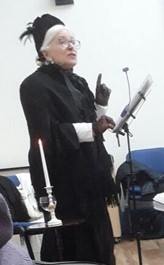
We kick started Christmas at our December meeting with a reading of ‘A Christmas Carol’ by Anita Fernandez, Chair of the Dickens Society, who came dressed in Dickensian costume and kept us enthralled with Scrooge’s interactions with the various ghosts of Christmas and his gradual change of character. Anita used Charles Dickens’ original script.
The whole evening was a delight. The audience was enthralled by the ghostly atmosphere that Anita’s delivery promoted. In many ways we were transported back to our collective childhoods, being read to by a kindly old Grannie.
2 February. Staffordshire County Archaeologist Shane Kelleher: Overview of Some Recent Archaeological Projects in Staffordshire.
Shane began by telling us that before any major works, such as a new housing estate, redevelopment of a town centre or infrastructure projects such as HS2 etc. can begin the remit of the archaeology department is to search for and record for posterity evidence of our history. He also said not all discoveries were of national interest, such as the Staffordshire Hoard, but that smaller ‘ordinary’ finds are nevertheless important for our understanding the history of our locale. As he said of archaeology, “It’s not all about the bling’.
These are just some of the projects that Shane covered in his talk to us.
Stafford History Centre
Whilst the new centre showcasing Staffordshire’s history was under construction it revealed new insights into the county town’s Anglo-Saxon past. Fragments of pottery – including one that could date back as early as the fifth century – were unearthed during excavation of the Eastgate Street site. The unassuming piece of cooking pot, which has carbonisation showing evidence of use as well as patterning, is believed to have been used sometime during the early to mid-Anglo-Saxon era. It could even pre-date the Staffordshire Hoard, which was unearthed in the south of the county more than 15 years ago, and no Anglo-Saxon finds of this date have previously been found in Stafford.
A second pottery piece was also found, which is an early example of how Staffordshire pottery was renowned across the country hundreds of years before the birth of Josiah Wedgwood and the rise of The Potteries to international fame. The piece, which could be around 1,100 years old, dates back to the Kingdom of Mercia and the period when Aethelflaed – Lady of the Mercians – was establishing burghs, or fortified settlements, in Stafford and Tamworth as part of actions to withstand the Danes.
Dove Cliff Weir Project
Shane told us about the Dove Cliff weir removal project, on the Derbyshire/Staffordshire border, was the biggest of its kind in the country. According to the Environment Agency, which carried out the work, the aim of which was to allow the free passage of fish along the River Dove and its tributaries for the first time in almost 900 years.
Whilst working on the removal of the weir on the River Dove, an ancient wooden structure was found, necessitating the intervention of archaeologists. Early indications suggested that the majority of the timbers were felled between AD 1525-1550, with other groups of timbers demonstrating repair and migration of the structure to the south during the 16th and 17th centuries. It would seem that the bypass channel timbers represent an earlier form of weir and as the river migrated southwards, either by natural or manmade processes, the weir was extended until it reached its present position.
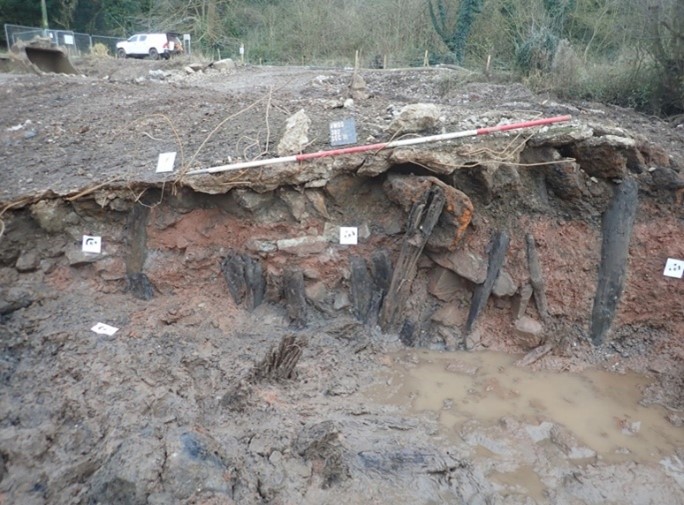
- The exact date the weir was built is unknown but the existence of a mill in the mid-14th Century and a small bridge in 1301 suggested some feature existed in the medieval period to manage water.
- Details of the weir are shown on Ordnance Survey maps from the 1880s onwards.
- During the first half of the 20th Century, the weir suffered from neglect and there were breaches reported in the 1950s and 1990s.
Source: Environment Agency
Black Flatts Solar Farm, Blithbury.
Archaeological features of limited significance were recorded in 22 trenches across nine fields. The remains of ridge and furrow cultivation of medieval/post-medieval date was identified in 25 of the trenches while 77 trenches contained no archaeological features.
HS2
In Handsacre in Staffordshire, a dig has uncovered the remains of an iron age house and a pit alignment, thought to have been used as a farming boundary during that period in the same way as hedges are today.
3 March. Cultural Heritage Officer, Dr. Mark Knight: Transforming the Trent Valley.
Dovetailing neatly with the previous talk by Shane Kelleher, Mark’s presentation was all about the projects concerning the hidden history beneath our unique Staffordshire landscape. The focus as the title would suggest was on the archaeological heritage that human activity around the Trent Valley has left behind since neolithic times.
After giving us a brief introduction to the river itself, such as the fact that it is the third longest river in UK at about 270 miles long and that unusually it flows north. He likened it to rivers such as the Mississippi, in that its’ natural habit was ‘bifurcated and anastomosed’ meaning rather than a single stream of flowing water it meandered over flood plains creating many small channels around ‘eyots’ or small islands. However, over centuries man has intervened in the pursuit of making a single ribbon of water to maximise land for farming.
This is just a snapshot of one of the elements of Marks fascinating and informative talk.
The story began around 5,000 years ago with the creation of the Catholme Ceremonial Complex. In the early 2000s, an archaeological team excavated a ritual landscape based around a series of ceremonial monuments focused on the confluence of three rivers, the Trent, Tame and Mease. It was discovered to have existed between about 3,000 BCE and 1,500-1,000 BCE. The importance and sanctity of this unusual triple confluence was of utmost significance to our forebears, and starting in the late Neolithic period, these monuments may have stood in the landscape for well over 1,500 years and influenced the building and placement of later Bronze Age burial mounds and other landscape features. This ceremonial complex was of very great importance and national significance, despite there being nothing visible above ground now.
It is well established that the prehistoric peoples of Britain believed that rivers were a representation of the feminine divine and that each river had its own goddess, or more correctly, that the river was a manifestation of the goddess herself. In this respect the River Trent, may well have been believed to be represented by a specific ‘earth being’, or goddess. Work by etymologists over the years reveals that the name of the goddess was Trisentona, shortened over the millennia to Trent. Efforts in the past to understand the meaning of the name resulted in translations such as ‘Trespasser’, ‘Flooding One’, or more tortuously, ‘the Great Feminine Thoroughfare’. More recently, whilst acknowledging the river as a manifestation of the goddess, there have been new theories about meaning of her name. Breaking the word into three parts, this results in the word Trisentona meaning something like ‘the goddess of great desire’, or perhaps better rendered in English as ‘greatly beloved’.
Mark himself had another theory; As the number three was of great significance, it was his contention that in the ancient past the three rivers were understood to have given birth to the triple goddess. The ritual landscape and ceremonial complex that stood for so very long acknowledged this. The goddess Trisentona’s name would then mean ‘thrice-beloved, and as a recognition of the ‘three-ness’ of the triple goddess and the importance of the confluence where three rivers meet.
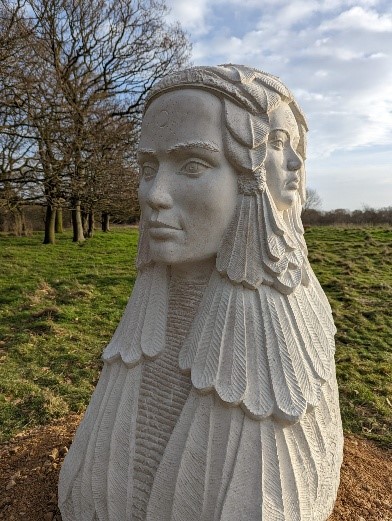
Source www.thetrentvalley.org.uk
6 April. Councillor Ann Hughes: The Impact of the Civil War on the People of Lichfield and its Environs.
Talk about going out with a bang! Our last meeting of the winter programme which was postponed from January was extremely well attended by 60 members and visitors. Ann has a long held interest in the Civil War of 16 and its’ relevance in Lichfield. Once asked to talk to our history society, she embarked on further research at the new history centre in Stafford to tailor her presentation for the Ridware audience.
Between 1642 and 1648 the English Civil War was fought between supporters of the monarchy, the Royalists or Cavaliers and those who supported the Parliamentarians, Roundheads. Stafford and Lichfield were largely parliamentarian, except for the Cathedral Close which was Royalist.
Lewis, son of John Chadwick and Joyce Cawarden of Mavesyn Ridware along with his childhood friend, Simon Rugeley joined on the side of the Parliamentarians at the outset.
Ann began by telling us that the Mavesyn Ridware Constable accounts are amongst the best preserved and most detailed in the country and illustrated the impact that the Civil War had locally. All communities had tax levies imposed on them to towards the cost of the war. The parish of Mavesyn Ridware was no exception. The accounts of local constables, like Henry Lowe of Mavesyn Ridware, reveal the financial strain placed on communities during the Civil War. For example, Henry Lowe’s accounts show that he paid out a significant sum in cash and delivered goods to meet the war-time levy. His accounts also showed that in 1644 Mavesyn was paying taxes to both sides. He or one of the two other constables had to go to Lichfield to pay £10 fortnightly to the Loyalist Royal Garrison and then to Stafford to pay the Parliamentarians. Both sides made an effort to reduce possible hardship for the inhabitants by lowering their levies by approximately a third. Not only was money sent but goods and ‘provisions’, Mavesyn sending coal and hay as well. Sometimes there were other unforeseen requisitions as was shown in the accounts in 1643, ‘Assessment to pay for five horses that were lost, (i.e. taken away by Col. Cromwill’s forces). In 1644 beds and bedding were sent to Lichfield. Labourers were often supplied to work on defensive structures at the garrisons either to build or to repair earthworks, such labourers were sent in 1644 and 1645. Their pay coming from their home community. The accounts also showed that ‘free quarter to soldiers and horses’ i.e. free food and lodging.
Most records and histories of this period show the part played by men in the communities, such as the constables, labourers and soldiers. Ladies of importance may also be mentioned but not ‘ordinary females’. The Mavesyn Ridware Constable accounts, maybe uniquely, include a reference to the house of a Mrs Mary Edwards, (query whether this means a drinking establishment?), where regular meetings were held for the ‘daily good’ such as raising money for the levy, sourcing food, replacing ‘lost’ horses and fodder or who could ‘put up strangers’ i.e soldiers.
As can be seen, all in all this was a time that upended the everyday life of the ordinary folk of Mavesyn Ridware.
We would like to thank those of you who have been able and willing to help putting away the tables and chairs after meetings – we understand that not everyone maybe in a position to do so!
If, however, you feel you could help with serving the teas/coffees before or with the washing up after meetings, that would be very much appreciated.